LoopStacks
The Loop Stack Runtime — The AI Call Stack
The agentic distributed runtime for structured intelligent systems.
Not an agent framework. Not an orchestrator. A runtime — the way software was always meant to run. Every AI invocation is a loop. Every loop has a type. Every execution leaves a trace.
Why agents weren't enough
An agent is a promise with no contract.
Which tools did it call? Unknown. What prompt was active? Whatever was in memory. Who authorized that API call? Nobody. Can compliance sign off? Absolutely not.
Which loops ran? LST trace, exact frames. What prompt was active? Version 7, promoted Tuesday. Who authorized it? LDAP group mapped to this realm. Compliance export? One click.
You can't govern what you can't see. You can't see what has no structure. The Loop Stack gives every AI invocation a name, a type, a boundary, a version, and a trace.
The trace
The Loop Stack Tree
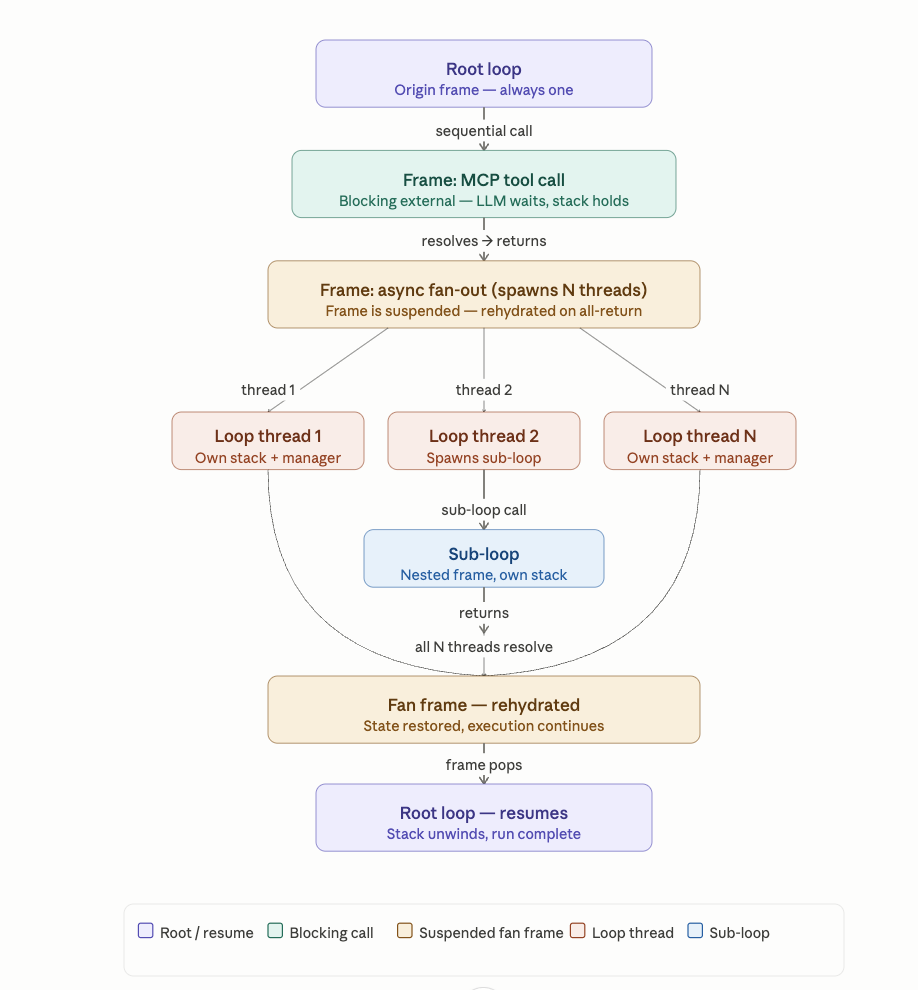
Every execution produces a structured tree — every frame, every prompt version, every child loop spawned, every tool call. Click any node. See everything. Export to compliance.
What is the Loop Stack Runtime?
Every AI invocation resolves to a loop. Every loop has a type. The runtime dispatches, traces, and governs — automatically.
Loop Registry
Every loop is registered with a type — LLM, MCP, or HTTP. The runtime resolves and dispatches. No framework lock-in. No rewrites. Register once, run anywhere.
Realm Governance
Your LDAP directory maps directly to realm boundaries. Every loop invocation is authorized before dispatch. Governance isn't bolted on — it's the runtime itself.
Loop Stack Trace
Every execution produces a Loop Stack Tree — a full trace of every frame, every prompt version, every child loop spawned. Click any frame. See everything. Export to compliance.
Prompt as Source Code
Every prompt is versioned, scored, and attributable. The runtime loads the active version at execution time. Promote a better prompt — it goes live instantly. No redeploy.
Kubernetes-Native
The runtime runs on your cluster. Sovereign by default — your data, your prompts, your traces never leave your boundary. Production-ready from day one.
Why the Loop Stack Runtime?
Every loop is traceable
Stop debugging black boxes. Every loop invocation produces a structured trace — parent frame, child frames, tool calls, prompt version, duration, output. The Loop Stack Tree is your audit trail.
LDAP maps to realms
Your identity infrastructure already exists. Map LDAP groups to realm boundaries and the runtime enforces invocation permissions before any loop executes. Governance your security team will actually approve.
Prompts are your IP
Every prompt version is stored, scored, and attributable to the executions it influenced. After a year of runtime data, your prompts are trained on your outcomes. That's not replicable.
From loop to production in minutes
Register a loop, set its type, define its tools. The runtime handles dispatch, tracing, retry, and governance. Deploy complex recursive systems without infrastructure complexity.
The primitive
Register a loop. Run it. See the trace.
registry.register({
  id:   'patient-risk-classifier',
  type: 'llm',
  llm: {
    model:        'claude-sonnet-4',
    systemPrompt: 'Classify cardiac risk from masked vitals.',
    tools: [{
      name:     'search_prior_cases',
      loopRef:  'case-retrieval-loop',  // spawns child loop
    }]
  }
})

const result = await executor.run(
  'patient-risk-classifier',
  { vitals: maskedRecord }
)

// result.trace — full Loop Stack Tree
// every frame, every tool call, every child loop
// prompt version at time of execution
// duration, output, LDAP identity that invoked it
The loop calls another loop. The runtime builds the trace. That's it.
The runtime era starts here.
LoopStacks is open-source and sovereign. Your loops, your prompts, your traces — running on your infrastructure. Join the community building the runtime layer for autonomous AI.